Underground eco-islands: waste collection solutions

From bell containers to bin platforms, the options for building underground collection points in urban, residential and public settings.

Explore the systems

What an underground eco-island is

An underground eco-island is an organised deposit point where the containers sit fully or mostly below ground. What stays visible depends on the system: deposit chutes, platforms or a paved cover.

There is no single layout. Bell containers and hydraulic platforms change how people deposit waste and how the operator empties it. The choice has to follow the collection service, not only the streetscape.

A neighbourhood island serves local users or a building complex. A municipal civic amenity site is a different facility, with other access rules and other streams. The two should not be mixed in a specification.

Sotkon APTO system diagram: shell, bell and deposit chute

The main options for underground collection

The layout depends on how waste is deposited, which containers are used and which vehicles empty them. Three families in the Bunder Waste catalogue cover the usual cases.

Underground containers · Recessed platforms

Crane emptying of an underground Sotkon APTO bell

Islands with underground bell containers

Sotkon APTO, distributed in Italy by Bunder Company, places a galvanised steel bell in a concrete shell. Users deposit through stainless steel chutes. Platform, chutes and container lift together on the vehicle crane.

Emptying is from above: Kinshöfer FLEX mushroom, twin hook, single hook with Palpeur, or F90 for cab-controlled bilateral collection. Vehicle, coupling and crane swing need checking at design stage.

The system is documented for neighbourhood islands, historic centres, squares and residential districts, in nominal sizes from 3 to 5 m³. Excavation drawings are issued with the project.

  • Deposit through stainless chutes (Diamond, Konik, Orion, Kynetik and others)
  • Crane emptying: FLEX, twin hook, Palpeur or F90
  • Nominal sizes 3, 4 and 5 m³
  • Safety platform closes the shell while the unit is lifted

View the system

Emptying diagram for Sounete Back platforms and wheeled bins

Islands with platforms for rear-loading bins

Sounete Back stores wheeled bins on a hydraulic platform. MRT chutes stay at street level. Waste sits in chambers below grade.

For emptying, the platform raises the bins to street level. Crews wheel them to the rear-loading compactors already in service, then set them back.

Documented layouts hold two to four bins of 1,000 to 1,700 litres (DIN). Check the vehicle fleet, slope (compensation up to 15% is stated for the system) and how hydraulics are powered: mains or a coupling on the truck.

  • MRT chutes with wheeled bins below ground
  • Scissor lift for rear-loading collection
  • 2 to 4 containers, 1,000–1,700 L
  • Sites served by rear loaders, including constrained streets

View the system

Emptying diagram for Sounete Side platforms and stationary containers

Islands with platforms for side-loading bins

Sounete Side stores stationary containers in a concrete shell. The platform rises on cylinders and a scissor linkage; the cover opens and the containers reach street level.

The reference emptying method is side loading, controlled from the cab. The product page also lists rear loading and crane containers, which matters when the fleet is mixed.

SD1 and SD2 hold one or two containers of 2,400 or 3,200 litres (up to 4,000 litres in dedicated setups). Align vehicle, remote control and shell works before specifying.

  • Stationary containers under a paved cover
  • Side-loading emptying, with rear-loading and crane options
  • One or two containers, 2,400 / 3,200 L
  • Hydraulic control from the cab

View the system

A layout for different urban settings

The same collection point changes with space, users and the service. The photographs show catalogue systems, not construction references.

For the condominium collection point, see also the page on condominium eco-islands. Condominium eco-islands.

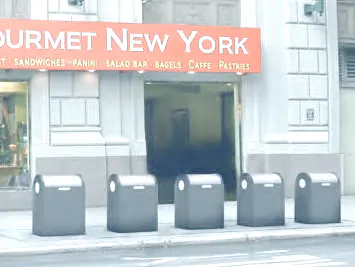
  • Sotkon APTO system with a deposit chute in an urban setting

    Historic centres and squares

    Where visual bulk, access and public-space constraints matter, chutes or platforms keep bins out of view. Vehicle manoeuvre still has to be checked.

    System photograph, not a project reference.

  • Sotkon APTO underground bells in a green residential area

    Residential districts

    One island can take several streams for users spread across an area. Capacity and emptying frequency follow the actual service volumes.

    System photograph, not a project reference.

  • Sounete underground platforms in an urban setting

    Apartment complexes

    Deposit can be concentrated in a dedicated area when space, subsoil and vehicle access allow it. It is not an automatic fit for every courtyard.

    System photograph, not a project reference.

  • Sounete hydraulic platforms for underground containers

    Street and square renewal

    When roads and squares are rebuilt, the island has to be coordinated with excavation, utilities and paving. Choose the system before civil works are closed.

    System photograph, not a project reference.

How an underground eco-island can be laid out

Stream count, capacity and emptying method change from one project to the next. The layouts below are illustrative examples, not built schemes.

Sotkon APTO bell containers side by side

Island with bell containers

Several Sotkon APTO units side by side, each with its chute, to separate streams. Each bell is emptied by a crane matched to the chosen coupling.

Illustrative example. Point count and streams are set on the project.

View the system

Sounete Back platform for rear-loading bins

Island with rear-loading platforms

One or more Sounete Back platforms, with wheeled bins matched to the operator’s rear-loading compactors. MRT chutes remain the deposit point.

Illustrative example. Point count and streams are set on the project.

View the system

Sounete Side platform for side-loading containers

Island with side-loading platforms

Sounete Side platforms set up for stationary containers and side-loading vehicles, or for the other emptying methods listed on the product page.

Illustrative example. Point count and streams are set on the project.

View the system

What to check before building an underground eco-island

These five points are enough to compare systems. Space, civil works and specification detail stay in the linked guides.

  1. 01

    Users and collection streams

    Which users the point serves and which flows are separated: food waste, paper, plastics, glass, residual or other streams in the local service.

  2. 02

    Capacity and emptying frequency

    Useful volume is read against collected quantities and the operator’s round. A larger size does not fix an incompatible vehicle.

  3. 03

    Space and civil works

    Plan area, depth, subsoil, utilities, access and the shell or chamber type. Project dimensions are not published on this site.

  4. 04

    Vehicles and collection method

    Crane and coupling for bells, rear loading for Sounete Back, side loading (or the documented alternatives) for Sounete Side.

  5. 05

    Access and maintenance

    Deposit, chute cleaning, chamber inspection and checks on lifting parts, as stated by the manufacturer of the chosen system.

Read the design guide

Access control and collection monitoring

On some systems you can add user identification, access control and fill-level reading. These are not standard on every product.

For Sotkon APTO the product page documents optional Sotkis integration: RFID, smart tags, fill sensors and charging linked to deposits. Sounete Back lists an access-control option. The Sounete Side page does not describe the same kit: it has to be checked separately.

Operational data supports rounds and maintenance. Detail sits on the sensor and smart-collection pages, not in one platform for every system.

Go further on design and system choice

The published guides remain the reference for sizing, system comparison and specifications. This page does not replace them.

Questions on underground eco-islands

Questions on underground eco-islands

Cost depends on the system, the number of containers, civil works and site conditions. Prices are not published: ask Bunder Waste with the project context.

Excavation, a shell or chamber, a utilities check and paving reinstatement. Geometry and loads differ between APTO bells and Sounete platforms. Dimensions come with the project pack.

It depends on the technology. APTO is emptied by crane with a documented coupling (Kinshöfer FLEX, hooks or F90). Sounete Back uses rear-loading compactors. Sounete Side is set up for side loading and, as stated on the page, also rear loading and cranes. Match the vehicle before choosing.

On underground systems the container sits below the walking surface and a chute or platform stays visible. On semi-underground systems part of the body remains above ground. Capacity, excavation and emptying are defined on each product page.

Yes, where the system provides for it. Sotkis integration is documented on APTO. Sounete Back lists an access-control option. Confirm it on the chosen configuration, together with sensors and local service rules.

Are you assessing an underground eco-island?

Bunder Company supports municipalities, operators and designers in choosing underground collection systems, based on the site, the service and compatibility with vehicles already in use.