
Guides and resources
Underground eco-islands: choosing a system by street, vehicles and users
Bells, hydraulic platforms or underground stationary bins: how to match the underground eco-island to road layout, collection vehicles and users.
Underground eco-recycling islands: choosing a system by street, vehicles and users
Choosing an underground eco-recycling island should not start from the largest container or the solution with the least visible clutter. The correct starting point is the collection service that must operate at the station.
Street, manoeuvring width, available vehicle, emptying method, number of users and waste quantities determine which system is technically compatible with the project.
The same city may need different configurations: a platform for wheeled bins on a narrow historic-centre street, a platform for stationary bins on easier-flow roads, or underground bell containers in a semi-urban peripheral zone.
The market also includes semi-underground systems, which can become relevant when site conditions make full burial less cost-effective. The contenitori-interrati.it Bunder Waste site includes both types, plus configurations for different collection methods.
Choice starts from the collection vehicle, not the container
The first fact to know is often verified too late: how will the eco-recycling island be emptied?
An underground container must be compatible with the lifting system, vehicle and operational methods of the contractor. Changing the station without considering the existing fleet can lead to a solution valid in absolute terms but poorly aligned with the real service.
ISPRA guidelines on urban hygiene service design also treat vehicle standards, containers and organisational collection methods separately. The relationship between equipment and service organisation is therefore a design element, not a later detail.
For the main underground configurations offered by Bunder Waste the link is fairly direct:
| Configuration | Indicated collection system | Typical context |
|---|---|---|
| Underground bell container | Vehicles with lifting and hoisting systems | Urban and semi-urban areas |
| Platform for wheeled bins | Rear-loading compactors | Narrow streets, historic centres |
| Platform for stationary bins | Side-loading compactors | Easy-flow streets |
| Semi-underground container | Depends on specific configuration and lifting system | Suburbs, extra-urban areas, ports, marinas and other contexts |
Use-context indications from the Bunder Waste site should be read as orientation criteria, not as a substitute for project verification on the individual site.
What are the main types of underground eco-recycling islands?
Underground bell containers
Underground bell containers concentrate collection volume below road level and are emptied from above.
The Bunder Waste site offers configurations with capacities of 3, 4 and 5 m³. Containers are steel and inserted in a monolithic prefabricated reinforced concrete shell; deposit is through external inlet towers configurable for different fractions. Emptying is by gravity via lifting systems such as Kinshofer, double hook or single hook, depending on configuration.
This solution can be particularly relevant when:
- high capacity per collection point is needed;
- the contractor has vehicles compatible with the lifting system;
- surface space must be reduced;
- the station is in an urban or semi-urban area;
- you want to concentrate several separate fractions in the same area.
The main point to verify is compatibility between container, lifting system and available vehicle.
Underground platforms for wheeled bins
Underground platforms allow wheeled bins to be placed below road level and brought to the surface during emptying.
The Bunder Waste system is configured for modules of 2, 3 or 4 containers and can house 1,000 or 1,700 litre bins. Lifting is via an electro-hydraulic scissor platform; the system can be powered by an integrated pump or by the collection vehicle when it has the foreseen connector.
It is a configuration particularly relevant for narrow streets and historic centres, where carriageway width or urban fabric may make large stationary containers and side-loading vehicles less practical.
The operational advantage is that the contractor can continue using bins compatible with rear loading, bringing them above ground only during emptying.
Underground platforms for stationary bins
The logic is similar, but containers and operational methods differ.
Platforms for stationary bins are designed for 2,400 or 3,200 litre containers and paired with side-loading compactors. The system brings the bin to road level during emptying and can be operated by the driver via a dedicated control.
This configuration is therefore more consistent with roads where the side-loading vehicle can pull alongside and operate in adequate conditions. The Bunder Waste site indicates it for easy-flow streets.
For the designer the difference from the wheeled-bin platform is substantial: volume, container type, collection equipment and operational methods all change.
How does the street influence the choice?
The street should not be considered only as physical space for the island.
You must also verify how the vehicle reaches the station and how it must position itself during emptying.
Narrow streets and historic centres
A historic centre may have:
- reduced carriageways;
- tight bends;
- close-built frontages;
- limited pavements;
- reduced manoeuvring space;
- paving to preserve;
- aesthetic constraints;
- heavy pedestrian presence.
In this context a solution based on rear-loaded wheeled bins can be attractive because it allows a collection method compatible with vehicles already used on this type of access.
Platforms for wheeled bins are indicated by the Bunder Waste site precisely for narrow streets and historic centres.
Wide, easy-flow streets
When the vehicle can pull alongside and operate without particular constraints, an island with stationary bins and side loading can become a coherent configuration.
Here the advantage is not only aesthetic. You can keep the operational logic of the side-loading compactor used by the contractor, while containers stay concealed when not being emptied.
Urban and semi-urban areas
Higher-capacity underground bells can also become relevant here.
The Bunder Waste site indicates them particularly for semi-urban areas, where greater operational space can simplify access for dedicated emptying vehicles.
Number of users determines required capacity
A station should not be sized on container count alone.
You need to understand how much waste it must actually handle and how often.
Sizing should consider, when available:
- number of users served;
- expected output for different fractions;
- emptying frequency;
- commercial activity;
- floating population;
- seasonality;
- deposit distribution;
- possible peaks;
- contractor objectives for service frequency.
A collection point in a stable residential district can have very different needs from one near restaurants, shops or hospitality.
The same applies to a tourist municipality. Capacity needed during high season can differ greatly from quieter months.
So the right question is not:
“What is the largest container I can install?”
but:
“What capacity keeps the planned service running without an oversized station or frequent overfilling?”
User type also changes configuration
Users are not all equivalent.
A station mainly serving homes can have a different deposit profile from one serving at the same time:
- homes;
- shops;
- restaurants;
- offices;
- hospitality;
- seasonal activity.
This affects quantity and timing of deposits.
Moreover, when the island has access control, design must account for how users are identified and authorised.
Bunder Waste configurations can be completed with hardware and software for access control and fill-level monitoring.
These functions can matter especially when the project foresees tighter deposit control or integration with service IT systems.
When does a semi-underground system make sense?
Full burial is not the only option.
A semi-underground container can be relevant when the project needs easier installation or when territory characteristics make it useful to keep part of the system above ground.
The Bunder Waste site includes semi-underground systems with external polyethylene shells or cement shells and internal containers in different materials. Configurations include volumes of 3 and 5 m³, plus solutions dedicated to other fractions. Among indicated contexts are suburbs, extra-urban areas, rural and mountain zones, ports and marinas.
Compatibility with the collection service remains central here too.
A semi-underground system should therefore not be chosen simply because it appears to need fewer works. It should be compared considering:
- available space;
- emptying method;
- useful depth;
- accessibility;
- capacity;
- civil works;
- visual impact;
- future management.
A practical matrix to narrow options
In a preliminary phase, a matrix like this can help:
| Design condition | Configuration to assess |
|---|---|
| Historic centre with narrow streets | Platform for wheeled bins |
| Wide access and side-loading vehicle | Platform for stationary bins |
| Urban or semi-urban area needing high capacity | Underground bell container |
| Extra-urban context or where full burial is less cost-effective | Semi-underground system |
| Need to control access | Underground/semi-underground system prepared for access control |
| Need to monitor fill level | Configuration with compatible sensors |
| Project with several separate fractions | Station sized for number and flows of fractions |
The table sets up reasoning. Final configuration always requires site and equipment verification.
Existing fleet can be the main constraint
For an environmental contractor, replacing or changing a station does not necessarily mean buying a new vehicle.
In many projects the aim is to use new infrastructure while keeping the operational logic of the existing fleet.
It is therefore useful to start with an equipment census:
what vehicles do we have today, what lifting systems do they use and what containers are already on the territory?
Only after this verification does it make sense to compare underground configurations.
For example, a solution requiring a different lifting system can affect the fleet, operator training and spare parts management. Conversely, a platform designed to work with bins and compactors already in use can fit more easily into the existing service.
Island design therefore becomes part of service design.
Space below road level matters as much as surface space
An underground island must be compatible with what is under the street.
Before final choice you should consider, depending on the project:
- available depth;
- underground utilities;
- utility networks;
- ground characteristics;
- water management;
- accessibility for installation and maintenance;
- required structure;
- paving reinstatement.
This is particularly relevant in historic centres and densely infrastructured areas.
Documentation from a recent AMIU Puglia procedure for supply and installation of underground eco-recycling islands in Bari included specific documentation for containers, price list and bill of quantities, including works linked to installation.
The eco-recycling island should therefore be treated as an intervention comprising equipment and works to insert it in the territory, not as a simple container to place on site.
Urban appearance and functionality must be assessed together
Appearance is often one reason a municipality assesses an underground solution, especially in squares, historic centres and tourist areas.
But urban appearance alone is not enough to determine configuration.
A well-designed system must at the same time allow:
- simple deposit for the user;
- safe access;
- emptying compatible with the fleet;
- accessible maintenance;
- capacity consistent with users;
- correct integration with paving;
- adequate manoeuvring space.
The project should therefore place user, operator, vehicle and urban space on the same level.
Which system to choose? A verification sequence
For a municipality or contractor starting a new project, this preliminary path can be effective:
1. Define the service
Which fractions must be collected? How many users must be served? What frequency is planned?
2. Analyse the fleet
Which compactors are available? Are they rear- or side-loading? What lifting systems do they use?
3. Analyse the street
Can the vehicle pull alongside? Is there enough space for operations? Are there width or manoeuvre limits?
4. Verify the site
What surface space is available? What is available below road level? Are there utilities?
5. Define capacity
Volume must relate to waste quantities and planned emptying frequency.
6. Set the technology level
Is a simple collection system enough or are access control, user identification or fill monitoring needed?
7. Compare underground and semi-underground
Only after defining service requirements is it useful to assess which infrastructure configuration is more consistent.
What to ask a supplier before a technical proposal
A generic request such as “quote for three underground islands of 5 cubic metres” may be insufficient.
To obtain a comparable proposal it is preferable to provide at least:
- station location;
- photograph or plan of the area;
- available dimensions;
- any utility documentation;
- number of users;
- fractions to collect;
- estimated volume;
- current or planned emptying frequency;
- type of available vehicles;
- lifting system;
- paving characteristics;
- any architectural constraints;
- access control needs;
- fill monitoring if required;
- works to be included in supply.
This data allows discussion of configuration before price.
The right question is not which system is best in absolute terms
Underground bell, platform for wheeled bins, platform for stationary bins and semi-underground system meet different needs.
The bell can align with a high-capacity station in an urban or semi-urban area. The wheeled-bin platform may suit narrow access and rear loading. The stationary platform integrates with side collection and streets where the vehicle can operate easily. Semi-underground systems can be assessed in contexts where full burial is not necessarily the most appropriate solution.
The right choice is the one that keeps territory, users, containers, civil works and collection fleet consistent.
To explore available configurations, see the section on underground eco-recycling islands or pages dedicated to platforms for wheeled bins, platforms for stationary bins and semi-underground containers.
Products that may fit your project
For projects like yours, many Bunder Waste customers start with these solutions. Compare capacity, use case and configurations before you get in touch for a quote.
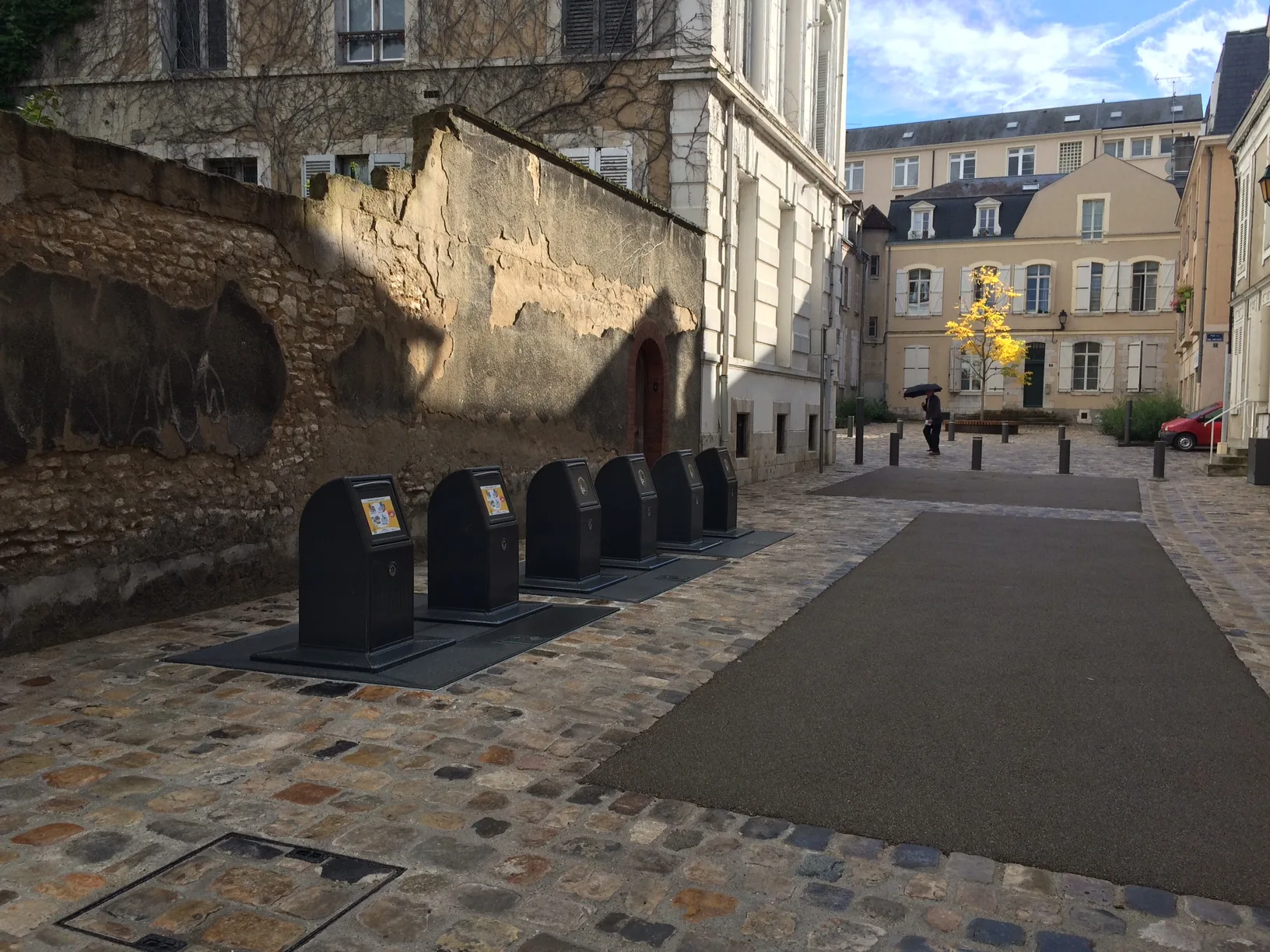
Ecollect · ECOBAC · 2000
2×1,000 L semi-underground system
ECOBAC 2000 carries two 1,000 L wheeled bins in a concrete vault for floodable ground.
View product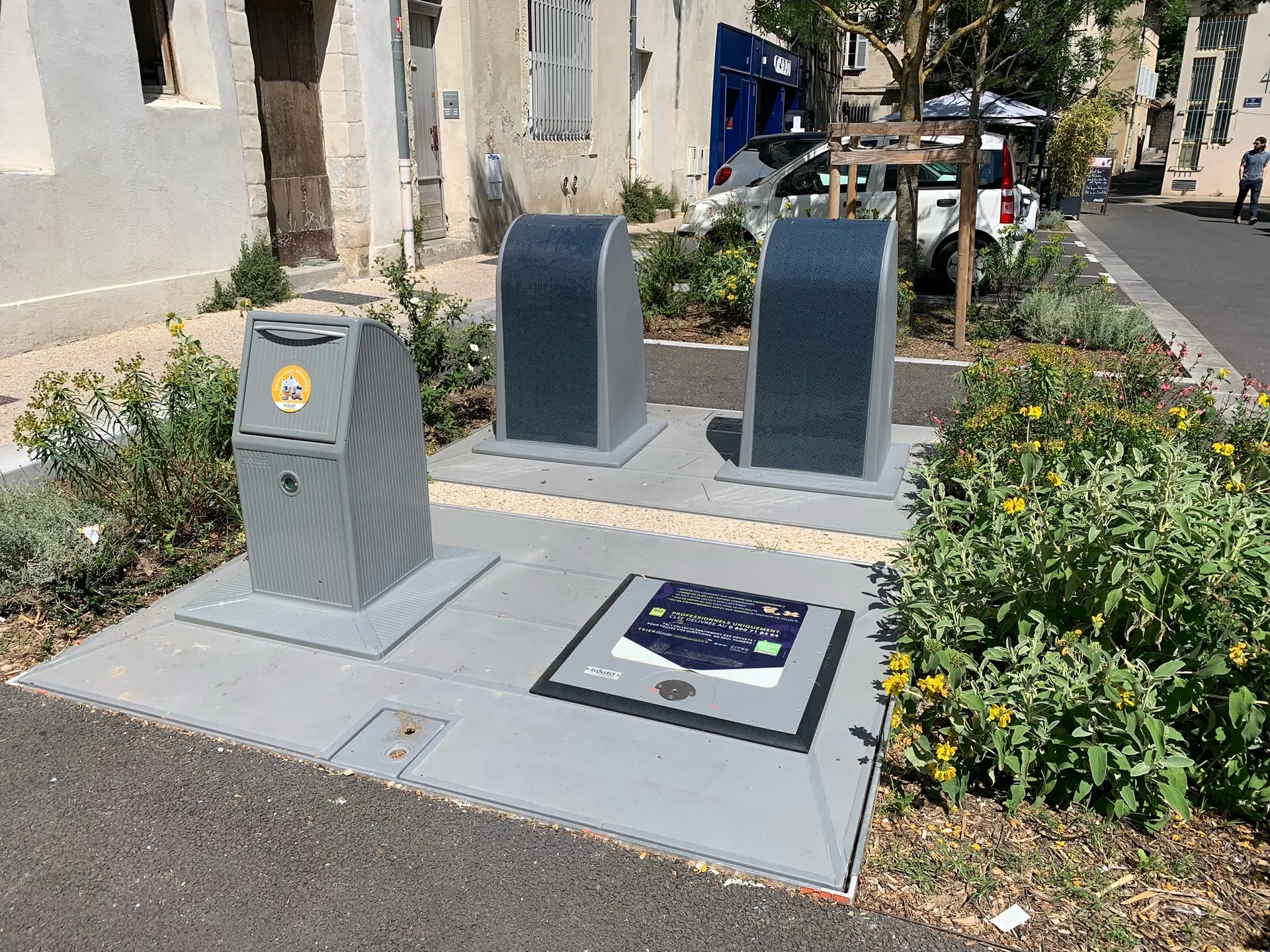
Ecollect · ECOBAC Solar
Semi-underground system with solar panel
ECOBAC Solar adds an integrated photovoltaic panel to the ECOBAC line, developed at Ecollect in Vaucluse, France.
View product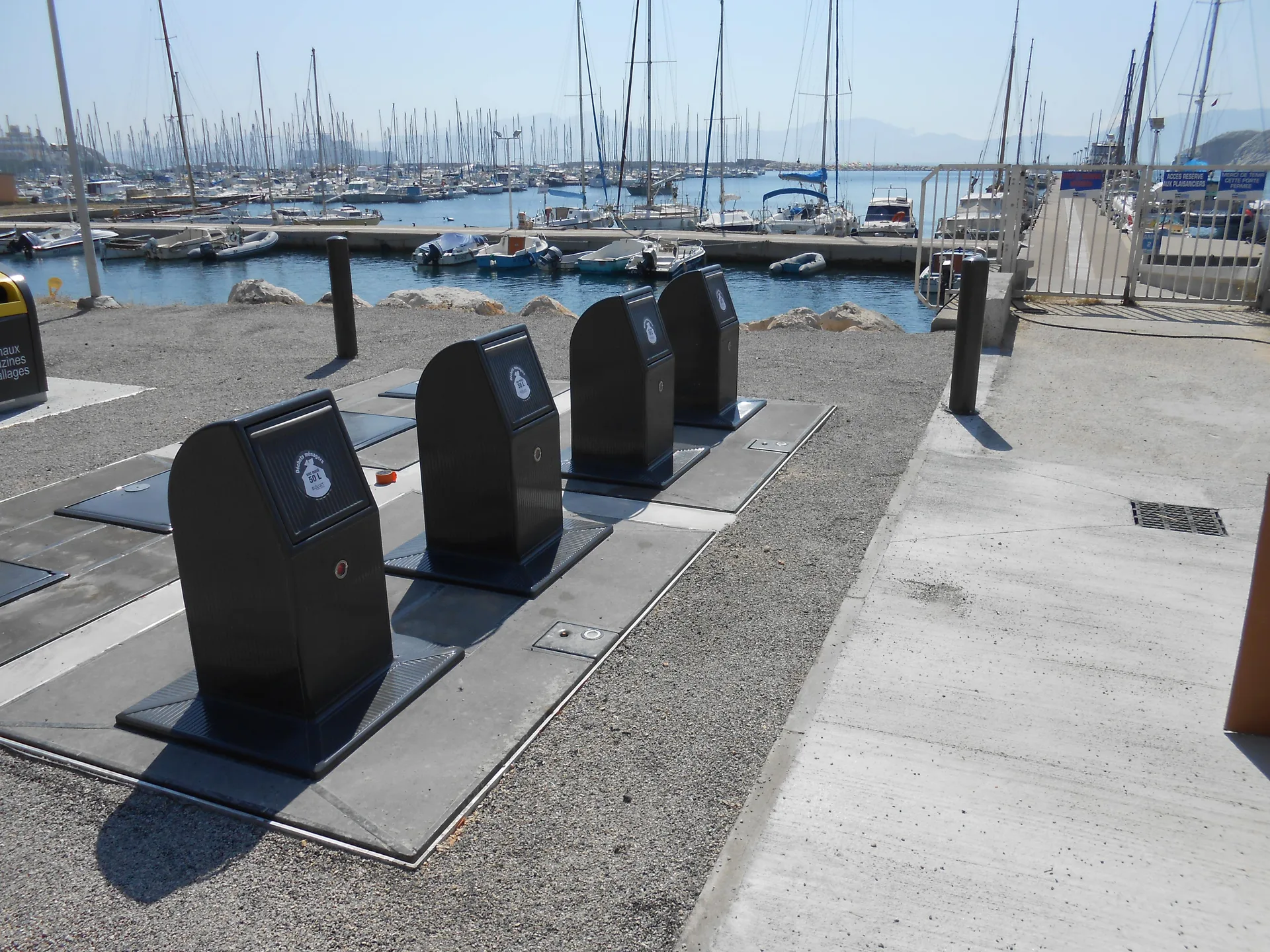
Ecollect · ECOBIG
High-capacity 4–5 m³ semi-underground unit
ECOBIG extends Ecollect to 4 and 5 m³ concrete vaults for high-volume urban collection.
View product
FAQ
Answers for your project
Which underground eco-recycling island best suits a historic centre?
When access is narrow and the service uses rear-loading compactors, an underground platform for wheeled bins may be appropriate. The final solution must be verified considering available space, vehicle, lifting system and emptying method.
When to choose a platform for stationary bins?
It is a configuration to assess when the contractor uses side-loading compactors and the street allows the vehicle to position and operate adequately. Bunder Waste indicates these platforms for 2,400 and 3,200 litre bins and for easy-flow streets.
When are underground bell containers indicated?
They are particularly suited to projects requiring high capacity per point and vehicles compatible with the lifting system. The Bunder Waste site offers configurations of 3, 4 and 5 m³.
Can an underground island use vehicles already in the service?
It may be possible, but compatibility must be verified. Lifting system, loading type and vehicle configuration must match the installed equipment.
How do you size an eco-recycling island’s capacity?
Capacity should be defined from users served, expected flows per fraction, seasonality and emptying frequency. Nominal container volume alone is not enough to size the station.
Is it possible to install an access control system?
Yes. Underground and semi-underground configurations on the Bunder Waste site can be integrated, depending on model, with hardware and software for access control and fill-level monitoring.
Are underground systems only for historic centres?
No. The Bunder Waste site indicates different configurations for urban, semi-urban, historic-centre, easy-flow streets and other territorial contexts. The selection criterion is compatibility between site characteristics and service organisation.
What is the difference between an underground and a semi-underground system?
In an underground system collection volume is placed mainly below road level. In semi-underground systems part of the structure remains above ground. Choice depends on site conditions, required works, capacity, emptying method and project objectives.